
AI Workflows & Automation
AI automation services that remove manual work from your operations. Custom agents and workflow pipelines plugged into the systems your team already uses.
The work is not beneath them. It is beneath what you are paying them.
AI automation for the work nobody should be doing
Somewhere in your operation is a spreadsheet that gets updated by hand. An inbox where requests get sorted manually. A report assembled every Monday from four different systems.
These processes share a pattern: high volume, clear rules, zero creativity required. They are exactly what AI agents do best, and exactly what most businesses still pay humans to suffer through.
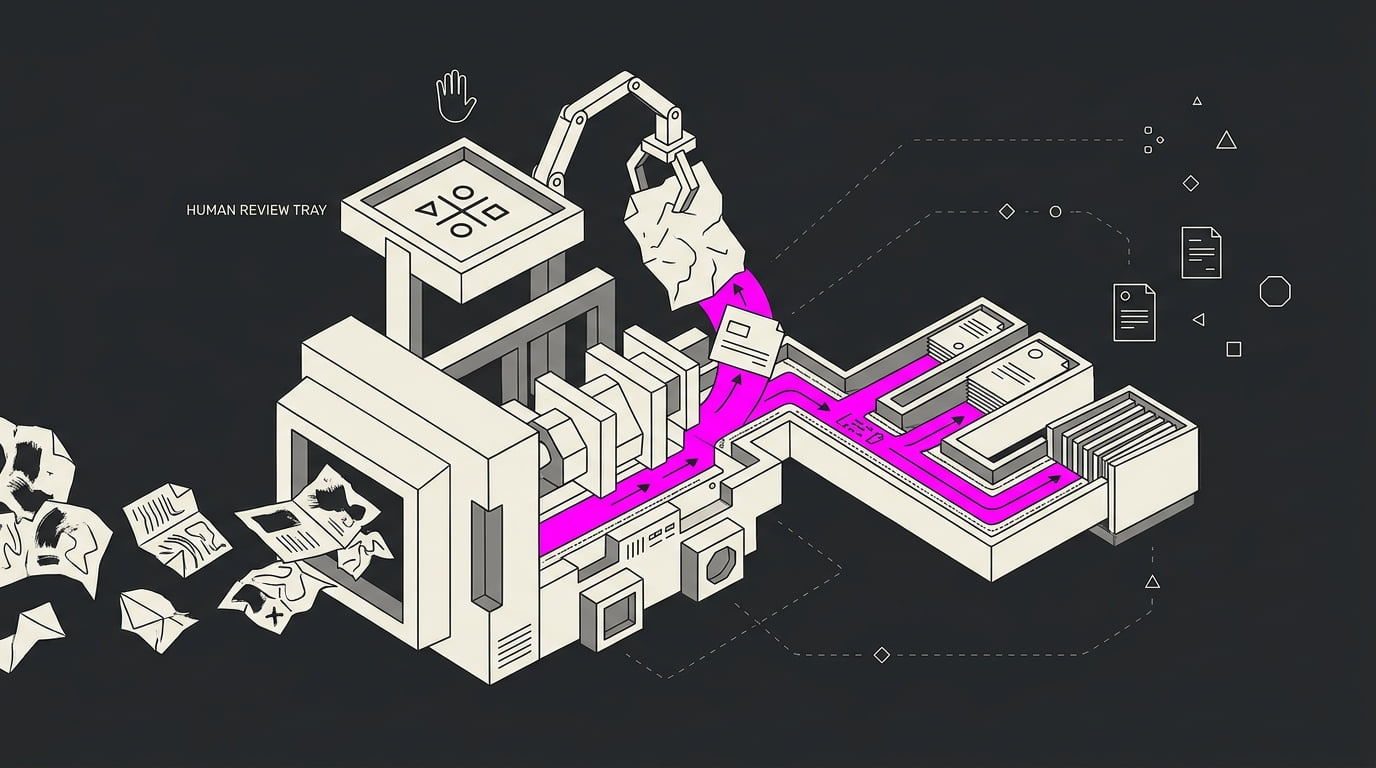
Automation here means building agents that read the unstructured input, make the routine decision, execute across your existing tools, and escalate to a human when confidence drops. Not a chatbot. A worker.
What you get
Process audit. Every candidate workflow mapped with volume, time cost, and automation feasibility scored.
Custom AI agents. Purpose-built for one job each: triage, extraction, routing, drafting, reconciliation.
System integration. Agents wired into your CRM, ERP, email, and internal tools through APIs and webhooks.
Human-in-the-loop controls. Confidence thresholds, review queues, and full audit logs of every automated decision.
Monitoring and reporting. Dashboards showing runs, accuracy, and hours saved, so ROI is a number instead of a feeling.
Iterative expansion. Start with one workflow, prove the math, then extend to the next.
How the engagement runs
Find the target.
Build narrow.
Measure.
Expand.
The economics, concretely
| Process profile | Manual cost | Automated cost | Payback |
|---|---|---|---|
| 10 hrs/week data entry | ~$8K/year | Build + minor run cost | Under 2 months |
| 20 hrs/week document processing | ~$16K/year | Build + token usage | 1 to 3 months |
| Full-time inbox triage | ~$30K+/year | Fractional | Under 3 months |
Do not automate the job. Automate the part of the job that made you stop hiring for it.
Who this is for
Operations teams buried in repetitive processing. Founders who cannot afford a fifth hire but need a fifth hire’s output. Agencies automating their own delivery overhead. Any business where someone said this week, again, that there has to be a better way. There is.

Start automating
OPENING DECEMBER 2026
Name the process that eats the most hours. The first conversation estimates the automation potential, the build effort, and the payback period in plain numbers.
Questions,
answered.
[ FAQ ]
Direct answers for founders and teams evaluating Huzaifa Web Studio as their technical partner.
Traditional automation follows fixed rules and breaks on anything unexpected. AI automation handles judgment: reading an unstructured email, classifying a document, deciding which department handles a request. The strongest systems combine both, with rules for the predictable parts and AI for the messy parts.
High-volume, rule-adjacent tasks with clear success criteria: data entry from documents, lead routing, support triage, report generation, invoice processing. If humans follow written instructions to do it, an agent can usually do it faster.
Hours returned per week multiplied by loaded labor cost, minus build and running costs. A process consuming 20 staff hours weekly typically pays back its build cost within one to three months.
Yes. Agents connect through APIs, webhooks, and export pipelines to CRMs, ERPs, email, spreadsheets, and internal databases. The goal is removing manual work, not forcing a platform migration.
Confidence thresholds route uncertain cases to a human review queue instead of guessing. Automation should fail safe, not confident.