Deployments & DevOps
DevOps consulting services for shipping teams. CI/CD pipelines, containerized deployment, and cloud infrastructure managed as code, so releases stay boring.
If releasing feels dangerous, the problem is not your developers’ caution. It is missing automation. Every manual step in a release is a place where a human can be tired at 6 PM on a Friday. DevOps engineering removes those steps.
Infrastructure engineered to be ignored
Good infrastructure is invisible. Deploys take minutes, rollbacks take one command, and nobody watches a terminal with their heart rate up. That state is not luck. It is pipelines, containers, and monitoring designed by someone who has been paged at 3 AM and decided never again.
The work here treats your deployment process as a product: versioned, tested, documented, and improved release over release.
What you get
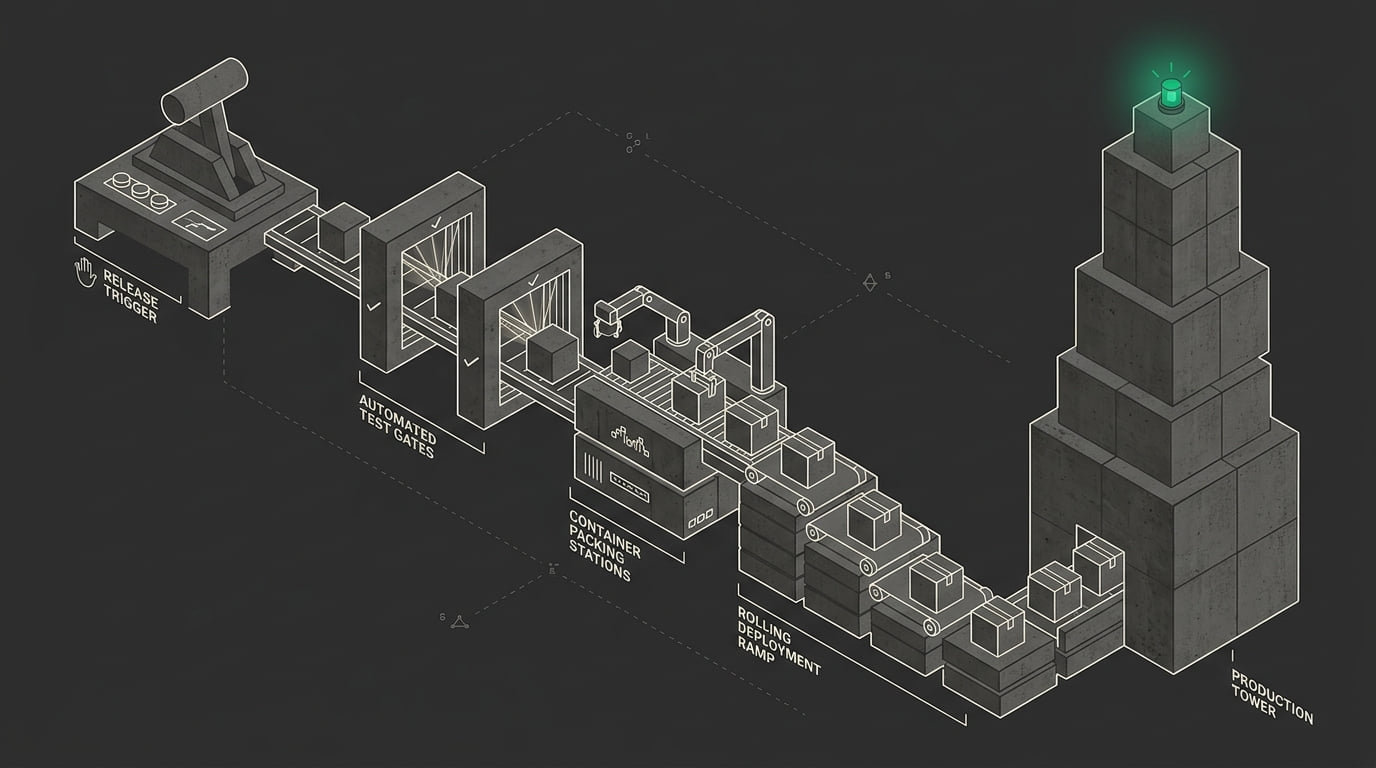
CI/CD pipelines. Automated build, test, and deploy on every merge, with preview environments for every pull request.
Containerized applications. Docker images built reproducibly, so staging and production run the exact same artifact.
Infrastructure as code. Cloud resources defined in version-controlled configuration. No snowflake servers, no undocumented console clicks.
Zero-drama deploys. Blue-green or rolling releases with health checks and one-command rollback.
Monitoring and alerting. Uptime checks, error tracking, and alerts that fire before customers do.
Environment parity. Local, staging, and production configured from the same source of truth.
How the engagement runs
Map the current path.
Automate the critical path.
Add the safety net.
Document and hand over.
Manual versus automated release
| Manual deploys | Engineered pipeline | |
|---|---|---|
| Release time | Hours | Minutes |
| Friday confidence | None | Total |
| Rollback | Tribal knowledge | One command |
| Environment drift | Guaranteed | Impossible |
| On-call pages | Surprise plot twists | Actionable alerts |
The best deployment process is the one nobody remembers exists.
Who this is for
Teams whose deploy checklist lives in someone’s head. Products that grew past FTP uploads and now need real infrastructure. Founders who are the CTO, the ops team, and the on-call rotation at once. Agencies that need client projects deployed on infrastructure they can trust.

Start automating
OPENING DECEMBER 2026
Describe how code reaches production today, including the parts that scare you. The first conversation identifies the highest-risk step and the fastest way to remove it.
Questions,
answered.
[ FAQ ]
Direct answers for founders and teams evaluating Huzaifa Web Studio as their technical partner.
Designs and implements the path your code takes from commit to production: build automation, testing gates, containerization, deployment scripts, environment configuration, monitoring, and rollback procedures. The goal is releases that are routine instead of risky.
Usually not. Most products run better on simpler infrastructure: containers on a managed platform or a single well-configured server. Kubernetes is recommended only when scale or team structure genuinely demands it. Complexity is a cost, not a credential.
Yes. The engagement starts by mapping the existing pipeline and its failure points, then replaces the fragile parts incrementally without freezing your releases during the work.
A standard pipeline for a web application runs one to two weeks: automated builds, test gates, preview environments, and one-command deploys with rollback. Legacy systems with manual steps take longer to migrate safely.
Yes, through a maintenance retainer covering monitoring, dependency updates, incident response, and periodic infrastructure reviews as your traffic grows.